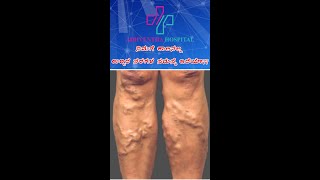
The Doppler scan for varicose veins: what it shows and how to read your report
What happens during a venous Doppler scan, why you stand for part of it, and what the words on your report mean: GSV, SFJ, reflux and perforators.


Before anyone treats varicose veins, they need a map of which veins are leaking. That map comes from a venous Doppler scan, also called a colour Doppler or duplex scan of the leg veins. It is the single most important test in deciding whether you need treatment and which kind.
What happens during the scan
It is an ultrasound, the same kind of scan used in pregnancy. There are no needles and no radiation. Gel goes on the skin and a probe is moved along the inside of the thigh, behind the knee and down the calf.
Part of the scan is usually done with you standing, or with the leg hanging down. Varicose veins are a problem of blood falling back down the leg under gravity, so the leak shows best when you are upright. The person scanning may squeeze your calf or ask you to bear down as if straining. This pushes blood up and then lets it fall back, so they can see whether the valves hold.
Wear loose clothes, or shorts, so both legs can be scanned. The scan takes about fifteen to thirty minutes for both legs.
What the scan looks for
- whether the deep veins are open and free of clots
- which superficial veins leak, and from where to where
- how wide the leaking vein is and how straight its path is
- leaking connecting veins (perforators) between the deep and surface veins
- how close the vein runs to the skin
The first point matters most for safety. If there is a clot in a deep vein, that is treated first, and varicose vein treatment waits.
Words you may see on your report
GSV and SSV
The great saphenous vein (GSV) runs up the inside of the leg from the ankle to the groin. The small saphenous vein (SSV) runs up the back of the calf to behind the knee. These are the two main surface veins, and most varicose veins come from a leak in one of them.
SFJ and SPJ
The saphenofemoral junction (SFJ) is where the GSV joins the deep vein in the groin. The saphenopopliteal junction (SPJ) is where the SSV joins the deep vein behind the knee. These junctions have valves, and they are a common starting point for the leak.
Reflux, or incompetence
Reflux means blood flowing backwards, down the leg, when it should be going up. An incompetent valve is one that lets this happen. Most labs count it as reflux when the backward flow in a surface vein lasts longer than about half a second. Your report may give the time in seconds or milliseconds.
Diameter
The width of the vein, in millimetres. It helps the doctor decide between laser, radiofrequency, glue and foam.
Perforators
Short veins that connect the surface veins to the deep veins through the muscle. Leaking perforators near the ankle are often involved when the skin there has darkened or an ulcer has formed.
Deep veins patent and compressible
Good news: it means the deep veins are open and have no clot.
Does a scan from elsewhere count?
A recent report helps the doctor plan, and you can send it before you come. Call 080 8897 6259 and the team will tell you how, including on WhatsApp. Because the treatment plan depends on very precise details, the team may repeat part of the scan before the procedure.
Who needs a scan
Anyone with visible varicose veins who is thinking about treatment, anyone with aching, heavy or swollen legs, anyone with darkening skin or a sore near the ankle, and anyone whose veins came back after earlier treatment. At Adhventha the scan is done in the hospital on the day of your consultation. To book an appointment, call 080 8897 6259.