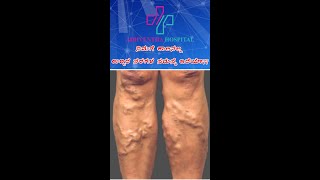
Radiofrequency Ablation for Varicose Veins
- No cut
- No stitches
- Through a pinhole
Laser or radiofrequency: which is better?
Both use heat to close the vein, and trials show similar results for closing the vein. Some studies found slightly less pain in the first days after radiofrequency, but the difference is small. The doctor chooses based on the size and path of your veins on the scan.
- Anaesthesia
- Local
- Cut
- Pinhole
- Time
- About 1 hour
- Home
- Same day
- Back to work
- 1–3 days
In detail
How it works
A thin radiofrequency catheter is passed into the faulty vein through a needle puncture, under ultrasound. Its tip heats the vein wall a short section at a time, which makes the wall shrink and seal. The catheter is moved down the vein section by section until the whole leaking length is closed. Blood then returns to the heart through the healthy deep veins.
Who it suits
Like laser, radiofrequency suits a leaking main vein in the thigh or calf that runs straight enough for the catheter to pass. The two give similar results, and the doctor picks between them on the size and course of your vein. Very twisted veins and small side branches are usually better treated with foam.
Step by step
- The vein is mapped with ultrasound and the skin numbed where the needle goes in.
- The catheter is passed up the vein and its tip placed just below the junction with the deep vein.
- Numbing fluid is injected around the vein along its length, which also protects the skin from the heat.
- The vein is heated and sealed one section at a time as the catheter is drawn back.
- A small dressing and a compression stocking go on, and you walk out.
The days after
Aching, tightness and a tender cord along the vein are common in the first week or two. Some studies found a little less aching in the first days after radiofrequency than after laser, but the difference is small. Walk often, wear the stocking as advised, and expect to be back at a desk within a few days.
Risks, plainly
The same as laser: bruising, aching and tightness are common; numbness in a small patch of skin, inflammation of the vein or skin staining happen less often; a deep vein clot is rare. The follow-up scan within a few weeks checks that the vein has closed and the deep veins are clear.
Radiofrequency ablation (RFA) and the other treatments
| Treatment | Anaesthesia | Cut | Time | Home | Back to work |
|---|---|---|---|---|---|
| Laser (EVLA) | Local | Pinhole | About 1 hour | Same day | 1–3 days |
| Radiofrequency (RFA) | Local | Pinhole | About 1 hour | Same day | 1–3 days |
| Glue (cyanoacrylate) | Local | Pinhole | Under 1 hour | Same day | Next day |
| Foam sclerotherapy | None | Injection | 15–30 minutes | Same day | Next day |
| Open surgery (stripping) | Spinal or general | Cuts at groin and leg | 1–2 hours | 1–2 days | 2–4 weeks |
Typical figures. Your doctor will advise what suits you.
First, a Doppler scan
A Doppler ultrasound scan of the leg shows which veins have failing valves and where blood is flowing the wrong way. It takes a few minutes, needs no needles, and it decides which treatment suits you. At Adhventha the scan is done in the hospital on the day of your consultation.
The day itself
- Consultation with an interventional radiologist and a Doppler scan, in the same visit.
- The procedure in the hospital's own cath lab, usually under local anaesthesia.
- You walk out of the room. Most people go home the same day with a compression stocking.
- A follow-up scan to confirm the vein has closed.
Cashless insurance
- ICICI Lombard
- Care Health
- HDFC ERGO
- Galaxy Health
- Magma HDI
- ManipalCigna
- Go Digit
- Aditya Birla Health
- Acko
- SBI General
- Medi Assist
- Health India TPA
Subject to your policy. Bring your insurance card.
Whether this treatment suits you depends on your scan and overall health. A consultation is the first step.
Sources
- NICE CG168: Varicose veins, diagnosis and management (National Institute for Health and Care Excellence, UK)
Medically reviewed by Dr. Bhaskar M V, Interventional Radiologist, on .
Close to you
- Kumaraswamy Layout · 1.3 km
- Jayanagar 4th Block · 2.2 km
- JP Nagar · 2.3 km
- Padmanabhanagar · 2.7 km
- Basavanagudi · 3.1 km
- Banashankari · 3.7 km
- BTM Layout · 4.2 km
- Uttarahalli · 4.6 km
- Hanumanthanagar · 5.6 km
- Girinagar · 5.8 km
- Konanakunte · 5.8 km
- Wilson Garden · 5.9 km
- Bannerghatta Road · 6.3 km
- Arekere · 6.3 km
- Bommanahalli · 6.8 km
- Shanthinagar · 7.3 km
- HSR Layout · 7.6 km
- RR Nagar · 7.6 km
- Hulimavu · 7.9 km
- Sarjapur Road · 8 km
By road, to Sangam Circle, Jayanagar 8th Block. Directions
Watch
Your doctors


Talk to an interventional radiologist.
Bring your Doppler report if you have one.